Active recall from your lectures: a study system
A practical active recall study method for university students: a semester plan built on lecture recordings, flashcard rules and a timed mock exam routine.
The active recall study method is simple to describe: instead of rereading your notes, you close them and try to pull the material out of memory, then check what you got wrong. Pair that with spaced repetition, coming back to the same material over days and weeks instead of in one long session, and you have the two habits learning research supports most consistently. If you record your lectures, you already have the raw material. This post shows how to turn those recordings into a weekly system: what to do after each lecture, how to write practice questions and flashcards that actually test you, and how to run a timed mock exam in the final week.
Why does rereading feel like studying when it isn't?
Rereading makes material feel familiar, and familiarity feels like knowing. But an exam doesn't ask you to recognize a page. It asks you to produce an answer from a blank prompt, and that's a different skill.
In 2013, John Dunlosky and colleagues published a long review in Psychological Science in the Public Interest comparing ten common study techniques. As the Association for Psychological Science summarized it, two techniques came out on top: practice testing (quizzing yourself with flashcards or end-of-chapter questions) and distributed practice (spreading study out instead of cramming). Rereading, highlighting and summarizing, the methods students use most, were rated low.
An earlier experiment by Roediger and Karpicke (2006) shows why the trap is so easy to fall into. Students either restudied a prose passage or tried to recall it. Five minutes later, the restudy group did better. Two days and a week later, the recall group remembered clearly more. The restudy group also felt more confident about how much they'd learned. In other words, the feeling that studying is going well is a poor guide to whether it is.
So the system below is built on two rules:
- Every session involves retrieval. You answer questions, recite before flipping a card, or explain a topic on a blank page.
- Every topic comes back more than once, with gaps in between. A bit of forgetting between reviews is expected. The effort of remembering is the point.
How do you build a semester plan from lecture recordings?
A folder of recordings is not a study plan. Thirteen unwatched lectures in finals week push you straight back to rereading. The fix is a small amount of work after each lecture, plus reviews on a fixed schedule.
Here's a plan for a typical 15-week semester with a midterm around week 8 and a final at the end. Adjust the weeks to your own calendar.
| When | What you do | Time (roughly) |
|---|---|---|
| Lecture day | Get a transcript or skim the recording, write a one-page summary and 8–12 questions | 30–45 min |
| Day 1–2 after | Answer the questions without notes, mark what you missed | 15 min |
| Day 7 after | Answer the same questions again, turn misses into flashcards | 15 min |
| Every weekend | Mixed flashcard review across all weeks so far | 20–30 min |
| Weeks 6–7 | List every midterm topic, do mixed quizzes, flag weak topics | 3 sessions a week |
| Midterm week | Two timed mock exams (see below), review only your misses in between | 1 session a day |
| After the midterm | Write new cards for anything that tripped you up | 30 min |
| Weeks 12–14 | Cumulative mixed quizzes covering the whole course | 2–3 sessions a week |
| Finals week | Two or three timed mock exams, cards only on the last day | 1 session a day |
The first two rows matter most. The questions you write on lecture day become the material for every later review. If you also go to office hours, bring the questions you couldn't answer; they're better than "I'm confused about chapter 4."
Rewatching is rereading
Watching a full recording a second time is rereading with audio. Use the recording as a reference: go back to a specific part only when you can't answer a question about it.
If you haven't set up the notes side yet, start with how to turn lecture recordings into study notes.
How do you write practice questions that actually test you?
Writing questions forces you to decide what matters, which is half the learning. Aim for 8–12 per lecture, mixed like this:
- Distinction questions (2–3): Skip "What is X?" and ask "How is X different from Y?" You can't answer that by reciting a definition.
- Why questions (2–3): Ask why the lecturer framed something the way they did. "Why does this study need a control group?"
- Application questions (2–3): Invent a new scenario and apply the concept. If the lecture used one example, find a second one yourself.
- Connection questions (1–2): Link this lecture to an earlier one. "Where does this model disagree with last week's?"
A few rules that make the difference:
- Keep answers out of sight. Write them on a separate page or the back of the sheet. If the answer is visible, you won't try to recall it.
- Mine the lecturer's signals. "This comes up on the exam," "a common mistake is," "make sure you understand this." These are easy to search for in a transcript and almost always worth a question.
- Build multiple-choice distractors from real confusions. The best wrong options are the concepts you or your classmates actually mixed up.
- Answer first, then check. Say or write your answer before you look. And always check: an uncorrected wrong answer gets rehearsed along with everything else.
What makes a good flashcard?
Flashcards are the easiest form of active recall, but a badly written card just trains recognition. These rules help:
- One card, one fact. One question on the front, one short answer on the back. If the back is a paragraph, split the card.
- Ask a question, don't write a label. Not "Opportunity cost" but "What do you give up when you choose option A over option B, and what is it called?"
- Use your own words. Copying the slide verbatim lets you skip understanding it. Rephrasing shows you where the gaps are.
- Go both directions for key terms. One card for term → meaning, one for meaning → term.
- Add a small context tag. Put the course and week in a corner. During mixed review it orients you without giving the answer away.
- No list cards. "Name the seven principles" fails halfway every time. Give each principle its own card, then add one card asking what problem the principles were designed to solve.
- See your misses more often. A simple box system works: cards you know come back weekly, shaky ones every two or three days, misses every day. A correct answer moves a card up one box; a miss sends it back to the first.
The best time to write a card
Right after you get a question wrong. A card written from a mistake targets exactly the spot you struggle with.
How do you run a timed mock exam?
In exam week, stop learning new material and rehearse the exam itself. A timed mock trains recall under pressure and teaches you to pace yourself.
Before
- Find out the format: number of questions, time limit, multiple choice or written. If past papers are available, use them first.
- Build a mock with the same number of questions, drawn from different weeks and in mixed order.
- Set the timer about 10% shorter than the real exam, to leave margin for the nerves you'll have on the day.
During
- Phone in another room, notes closed, timer visible.
- If a question takes more than twice the average time per question, mark it and move on.
- Come back to marked questions at the end. When time's up, pens down.
After (the part that matters most)
- Sort every miss into one of three groups: didn't know it, knew it but mixed it up, ran out of time.
- Didn't know it: go back to that part of the recording and write a flashcard.
- Mixed it up: write a card that contrasts the two concepts directly.
- Ran out of time: in the next mock, track time per question.
Two mocks in the final week, with miss-only review in between, is enough for most courses. The day before the exam, skip the mock: run through your cards once, look over your last set of mistakes, and sleep.
Where does Kivilio Voice fit in?
The slowest part of this system is the lecture-day prep. Kivilio Voice does that prep from the recording: upload a lecture or paste a YouTube link and you get a timestamped transcript, a summary, chapters and flashcards, and you can also create a 12-question multiple-choice quiz, a timed exam, a mind map and a PDF study guide. Processing runs in the background.
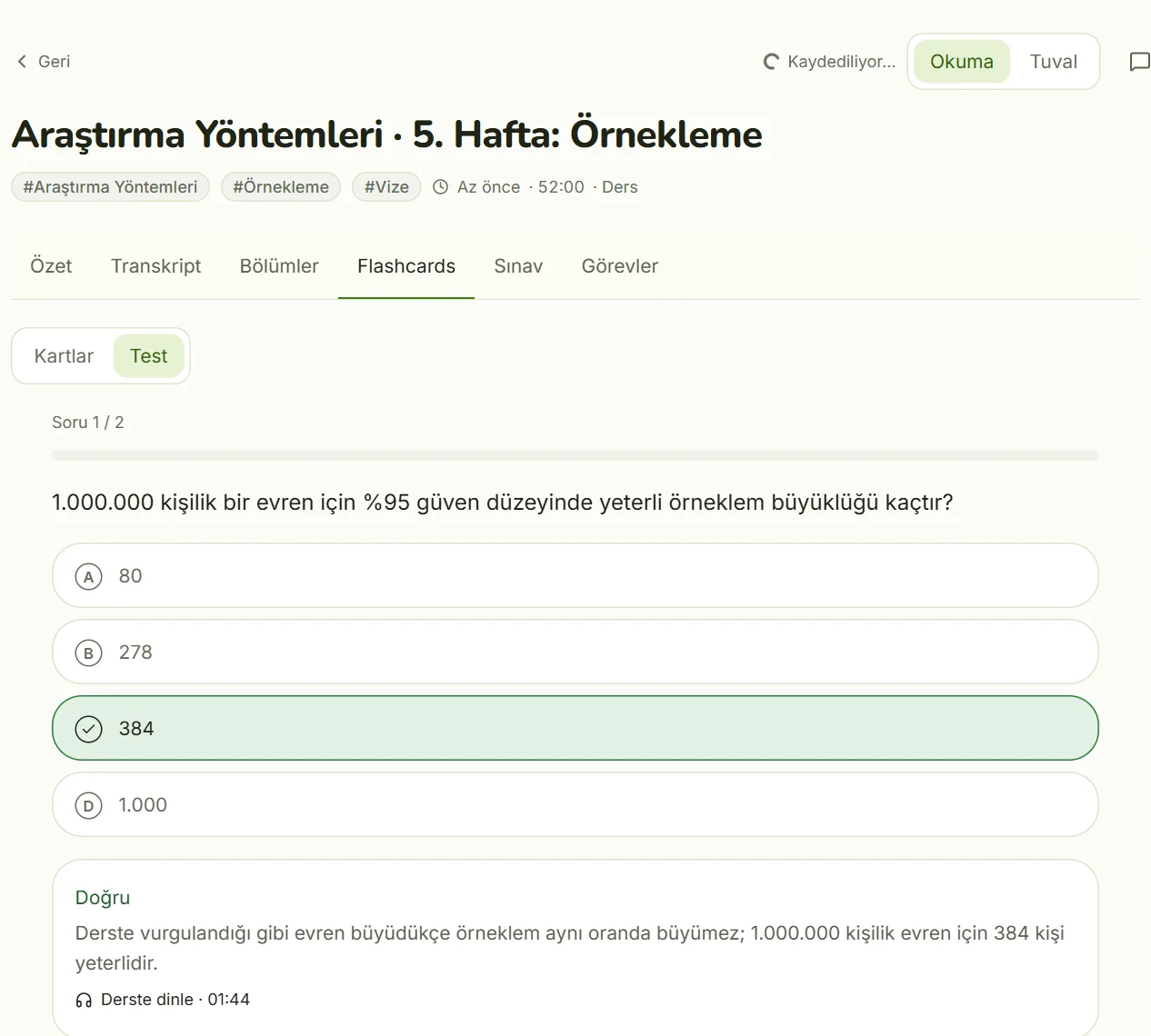
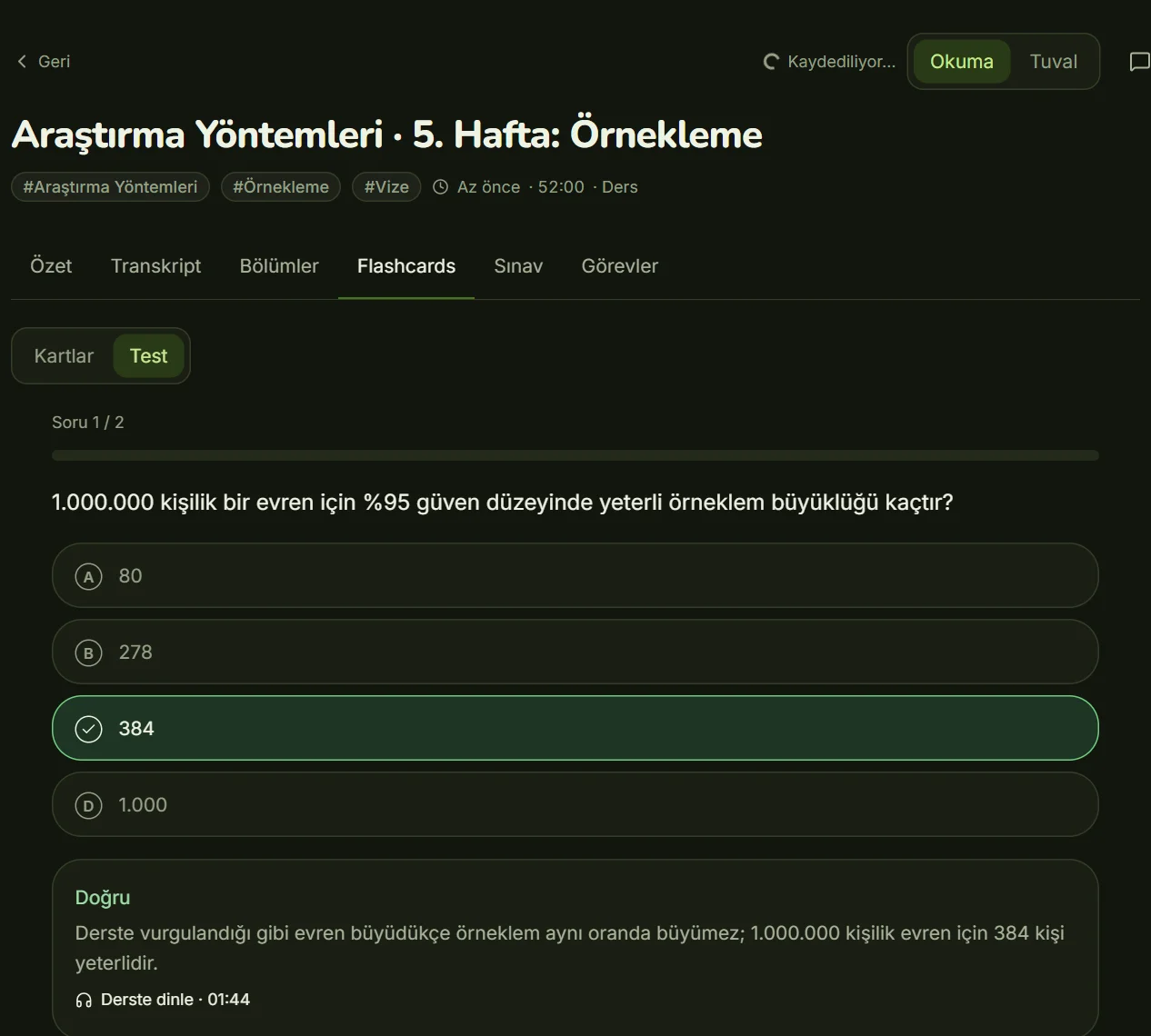
It speeds up the system rather than replacing it. Answer the generated questions, note your misses, and still rewrite the most important cards in your own words. In exam week, the timed exam works as your mock.
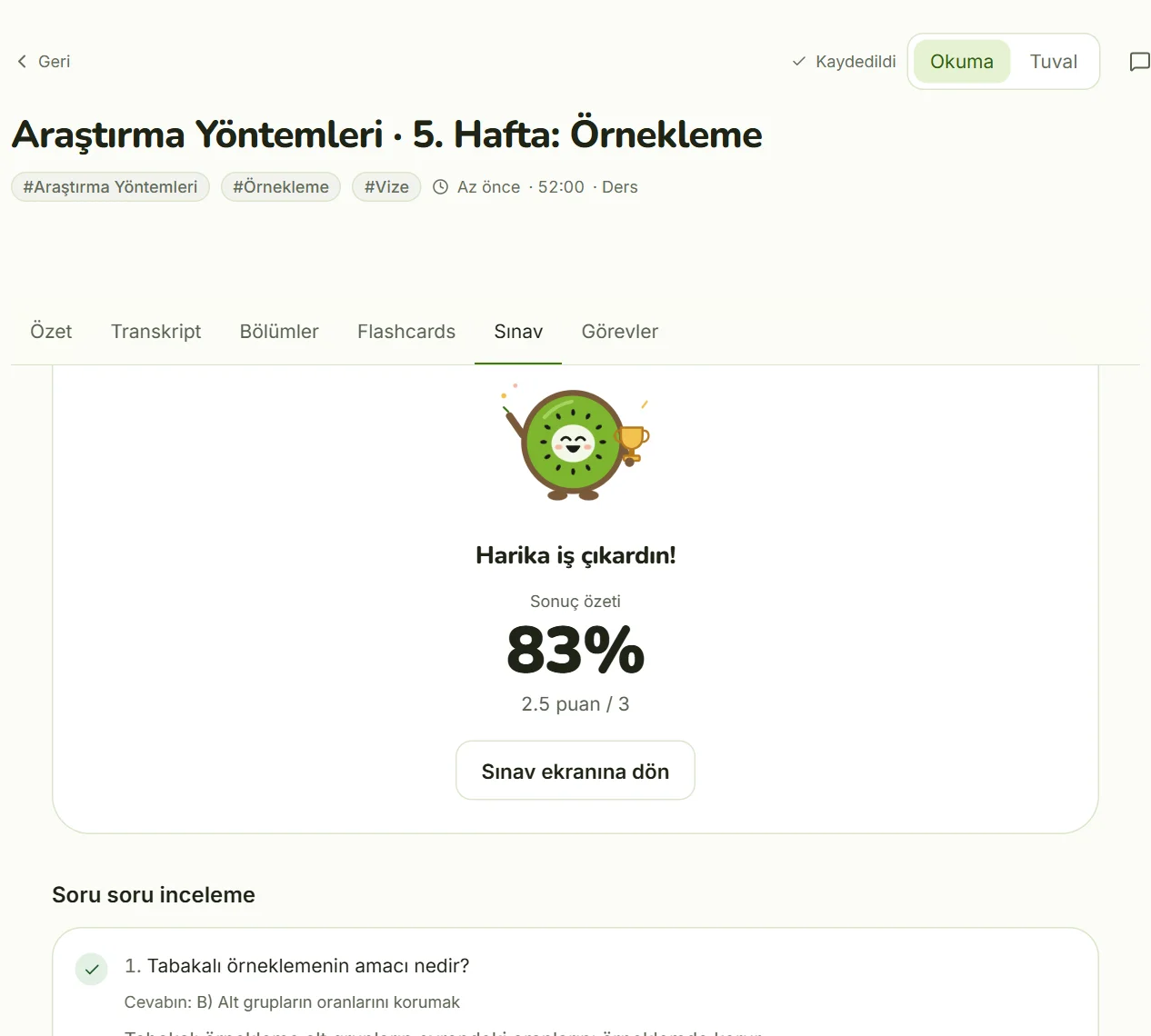
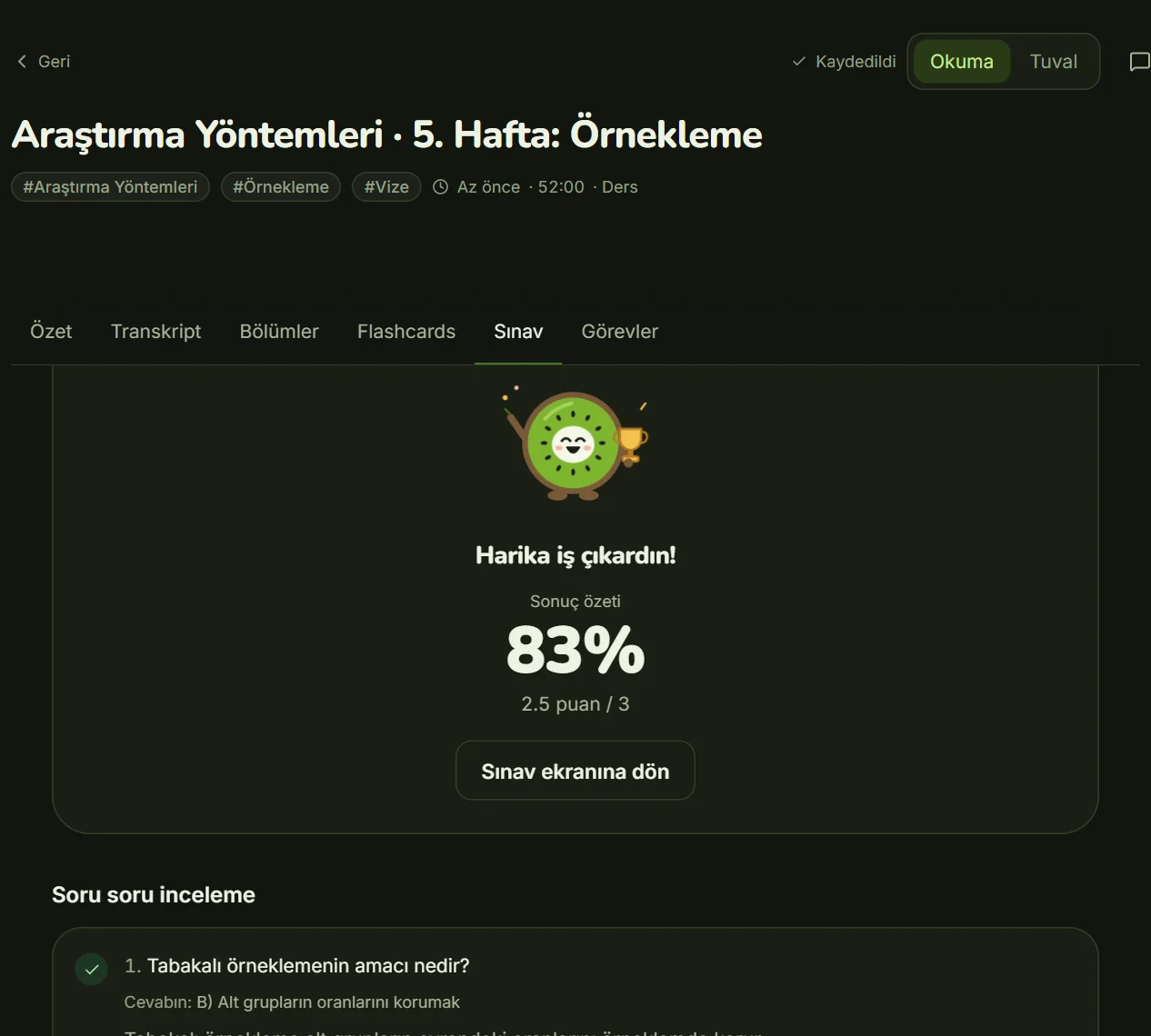
More on the study tools: exam prep from lecture recordings.
FAQ
How long should I study each day? Consistency beats hours. Thirty to forty-five minutes on lecture day plus a few short reviews a week does more than a three-day cram, because spacing is itself one of the most effective techniques.
Is summarizing a waste of time? On its own it's a weak technique, but a summary is good raw material. Don't just read it; turn each heading into a question and study with those.
Am I allowed to record my lectures? It depends on your university and your lecturer. Ask first and check your institution's policy. If you need recordings as an accommodation, your disability or accessibility services office can help. Keep recordings for your own study.
Do I need a flashcard app? No. Paper cards and three boxes follow the same principle. What matters is trying to recall the answer before you flip the card.
What should I do the night before the exam? No new topics and no long mocks. One pass through your cards, a look at your last mistakes, then sleep.
Kivilio newsletter
New articles, product news and short tips.