Generate a quiz from your lecture: a guide for teachers
How to turn lecture content into good quiz questions: multiple-choice writing rules, Bloom's levels, a reusable question bank and how to review AI drafts.
To generate a quiz from a lecture that actually measures learning, start from the lecture's learning objectives, write (or generate) a few questions per objective at different cognitive levels, and check every item against basic multiple-choice rules before students see it. Saved properly, that work becomes a question bank you can reuse every term. This guide covers writing solid multiple-choice items, moving beyond recall, building a bank from lecture recordings, and why AI-generated questions always need your review before they reach a graded quiz.
What makes a multiple-choice question work?
A multiple-choice item has a stem (the question) and a set of options: one correct answer, called the key, and several distractors. A weak item either trips up students who know the material or hands the answer to students who don't. Either way, the score stops telling you what students learned.
A widely cited summary of item-writing advice is Haladyna, Downing and Rodriguez's 2002 review in Applied Measurement in Education. Drawing on 27 educational measurement textbooks and 27 research studies and reviews published since 1990, the authors set out 31 guidelines intended mainly for classroom assessment. Here is a practical version of the points that come up most often.
The stem
- Make it answerable on its own. Cover the options and read the stem. If a well-prepared student could answer it as a short-answer question, it's a good stem.
- Test one idea. If an item checks two facts at once, a wrong answer doesn't tell you which one the student missed.
- Avoid negatives. "Which of the following is NOT…" tends to test careful reading more than understanding. If you must use one, put the negative word in bold.
- Cut the padding. Background the question doesn't need only tests reading speed.
The options
- One key, and only one. If a colleague in your field could defend a second option, rewrite the item.
- Keep options parallel. Similar length, same grammatical form. Students learn fast that the longest, most qualified option is often correct.
- Go easy on "all of the above" and "none of the above." A student who spots two correct options can pick "all of the above" without knowing the third.
- Balance the key position. Across the bank, correct answers should be spread roughly evenly across A, B, C and D.
The distractors
A good distractor is a wrong answer that a student with partial understanding would genuinely choose. The best source is your students: common mistakes on past exams and the misconceptions you hear in office hours. A joke option effectively turns a four-option item into a three-option one.
Here's a quick before and after from an intro economics course. The weak version:
Which of the following is NOT true about price ceilings? A) They are set by governments B) They can cause shortages C) They raise prices D) All of the above
A stronger version:
A city caps monthly rents below the market equilibrium. What is the most likely short-run effect? A) A surplus of rental units B) A shortage of rental units C) No change in the quantity of units supplied D) A rise in market rents
The second stem stands on its own, the options are parallel, and distractor A comes from a confusion students really make: mixing up price ceilings and price floors.
How do you write questions that go beyond recall?
Question banks fill up with definition questions because they're the easiest to write. But your course objectives probably ask for more than "define." The revised Bloom's taxonomy, published by Anderson and Krathwohl in 2001, sorts cognitive processes into six levels: remember, understand, apply, analyze, evaluate and create. The University of Waterloo's Centre for Teaching Excellence has a clear guide to Bloom's taxonomy with example activities and assessments for each level.
Tag each question with a level and the gaps show up quickly:
| Level | Example stem | Works as multiple choice? |
|---|---|---|
| Remember | "In which phase of mitosis do chromosomes line up at the cell's equator?" | Yes |
| Understand | "Which scenario is an example of opportunity cost?" | Yes |
| Apply | "What is the median of the data set below?" | Yes |
| Analyze | "Which variable in this study design is a likely confound?" | Yes, with a good scenario |
| Evaluate | "Which of two proposed designs better meets the stated constraints?" | Partly; justification suits short answer better |
| Create | "Design an experiment to test this hypothesis." | No; use a written task or project |
A useful rule of thumb: don't let more than about a third of a unit's questions sit at the remember level. For apply and analyze items, short scenarios do the heavy lifting. Swap the example you used in the lecture for a new case, a new data table or a new passage, and ask students to work with the concept there.
How do you build a question bank from lecture recordings?
If you record your lectures, you already have the richest source material there is: how you explained each idea, which examples you used, and the moments you said "this is important." Here's a workflow that turns that into a bank:
- Get a transcript. A searchable transcript lets you find question-worthy moments without rewatching. Search for phrases like "on the exam," "common mistake" or "make sure you understand."
- Write the learning objectives. Two or three sentences per lecture: "By the end of this session, students should be able to…" Every question links back to one of these.
- Write 2–4 questions per objective. Spread them across Bloom's levels, so the same concept is tested both for recognition and for application.
- Tag every item. Week or lecture, objective, Bloom's level, key, and the timestamp in the recording where the topic comes up. The timestamp saves time when a student disputes an answer or you revise the item.
- Use it, then prune it. After a quiz, flag items that almost everyone got right, almost everyone got wrong, or that your strongest students missed. Fix them or retire them.
A spreadsheet is enough to start. What matters is knowing where each item came from and what it measures.
Why do AI-generated questions need your review?
AI tools can draft dozens of questions from a recording in minutes, a real time-saver for a first draft. But a generated question isn't your question until you've checked it and decided it belongs in your assessment.
Never use AI drafts unchecked
Generated items can contain factual errors, more than one defensible answer, or questions about material you never taught. On a graded quiz, a single flawed item means appeals, regrading and lost trust.
Run every generated item through this checklist:
- Accuracy: Is the key actually correct, and can you point to where it's covered in the lecture or readings?
- Single best answer: Could any distractor be defended from a reasonable angle?
- Scope: Does the question stay within what you taught, at the depth you taught it?
- Level: Which Bloom's level is it, and does the bank already have plenty at that level?
- Wording: Is the stem clear, and does it use the same terms you used in class?
- Distractors: Are they based on real student errors, or easy to eliminate?
One more check if you're working from recordings: a term or name the transcript got wrong will carry straight into the question. For names, formulas and numbers, jump to the timestamp and listen.
How should you share questions with students?
A question bank serves two purposes, and they work best when kept apart:
- Practice questions are shared openly so students can test themselves. Retrieval practice is one of the best-supported study strategies, so giving students good questions is a direct way to help them learn. If you want to point students to a study routine built around those questions, our guide to active recall from lecture recordings is written for them.
- Graded questions stay separate. They can test the same concepts as the practice set, but they shouldn't be the same items, or you end up grading memorized answers.
Release practice questions with the answer key on a separate page, and note the lecture or timestamp next to each item so students can go back to the explanation. Short, low-stakes quizzes during the term give students early feedback and show you how your items perform before they count.
Where does Kivilio Voice fit in?
The slowest part of building a bank is the first draft. Kivilio Voice works from the recording: upload a lecture or seminar (or paste a YouTube link) and you get a timestamped transcript, a summary and chapters, and from the same recording you can create a 12-question multiple-choice quiz and a timed exam. Processing runs in the background. Files sent to Google (the Gemini API) for analysis are deleted when the job is done.
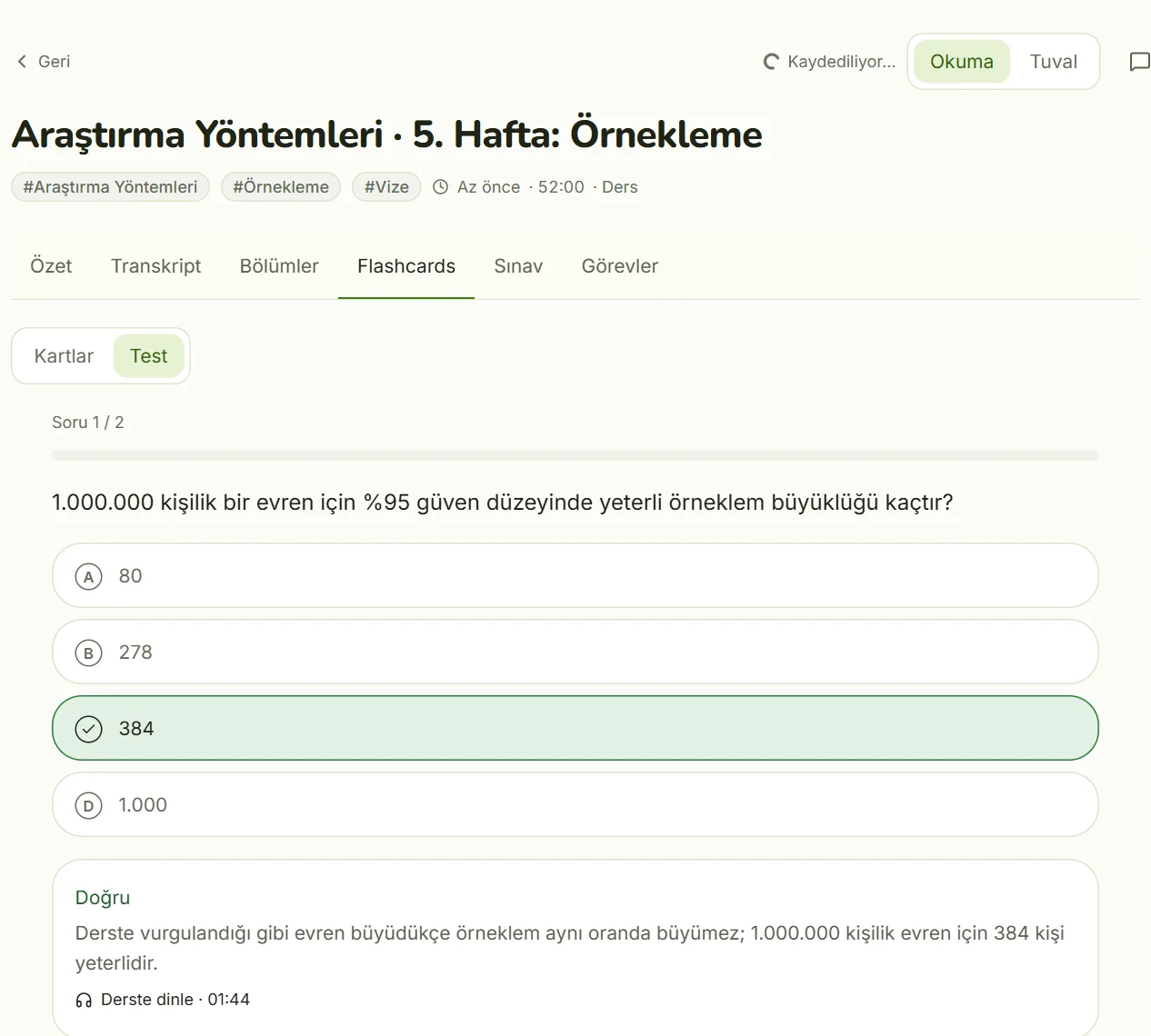
Treat those questions as a draft to review, not a finished quiz. Put each one through the checklist above and add the ones that pass, with your edits, to your own bank. You can also share a recording or a whole course folder with students through a link and turn sharing off whenever you like. More at Kivilio for academics.
Frequently asked questions
How many options should a multiple-choice question have? There's no magic number; what matters is that every distractor is plausible. If you're inventing a silly fourth option to fill the slot, fewer strong options are better.
How many questions should a question bank have? Enough to build at least two quizzes per unit is a good start. That lets you keep practice and graded items separate and avoid reusing the same questions every year.
Can I use AI-generated quiz questions as they are? It's not a good idea. Treat them as a fast first draft and check each one for accuracy, a single correct answer and scope. On a graded assessment, responsibility for every item sits with you as the instructor.
Can multiple-choice questions test higher-order thinking? Analysis, and to some extent evaluation, can be tested with a well-built scenario or data set. For creating or designing something, use a written response, an assignment or a project.
Do I need permission to use lecture recordings this way? Check your institution's recording policy, especially if students speak on the recording, and let students know when a session is recorded. Before turning transcript content into questions, verify terms and numbers against the audio.
Kivilio newsletter
New articles, product news and short tips.