Resume with no experience: examples that work
What to put on a resume with no experience: a full entry-level example, a summary formula, skills that count, and how to turn class projects into bullets.
A resume with no experience works when it swaps the job history you don't have for evidence you do have: class projects, internships, part-time jobs, volunteering, campus roles and relevant coursework. Employers hiring for entry-level roles aren't expecting years of work. They're looking for proof that you can take on a task, finish it and work with other people. Below: a complete example resume, a summary formula, which skills to list, and how to turn projects and part-time jobs into strong bullets.
What can you put on a resume when you have no work experience?
"Experience" doesn't have to mean a full-time job. Any real work with real stakes can count:
- Class and capstone projects. For many new grads, this is the strongest material on the page. Describe the problem, the method or tool you used, and the outcome. If it was a team project, say what your part was.
- Internships, including short or unpaid ones. List what you produced, not just where you were: a report, a spreadsheet model, a set of social posts, a process document.
- Part-time and seasonal jobs. Retail, food service, tutoring, campus jobs. Handling customers, closing out a register, training new hires and working a rush are all transferable.
- Volunteering. If it's related to the job you want, it can sit under an "Experience" heading. If not, give it its own "Volunteer Experience" section.
- Campus organizations and leadership. Membership alone says little. The role says more: treasurer, event lead, editor, team captain.
- Certifications and relevant coursework. Pick the few that connect to the job. Three meaningful ones beat a long list of short online badges.
For each line, ask whether it shows something the job post asks for. If not, cut it. For most new graduates in the US, one page is plenty.
What does a resume with no experience look like?
Here's a complete example for a fictional new graduate applying for entry-level marketing and communications roles. The name, school, employers and contact details are made up for illustration.
Jordan Lee
Columbus, OH · (614) 555-0142 · [email protected] · linkedin.com/in/jordanlee-exampleSummary
Communication graduate with hands-on content experience from a campus newspaper and a semester-long social media campaign for a local nonprofit. Comfortable with Canva, Google Analytics 4 and short-form video editing. Looking for an entry-level marketing coordinator or communications assistant role.Education
B.A. in Communication, minor in Business · Example State University · May 2026
- Relevant coursework: Digital Marketing, Public Relations Writing, Media Analytics, Visual Communication
- Capstone: Planned and ran a 10-week Instagram and email campaign for a local food bank with a team of four; I wrote the content calendar and the weekly performance reports.
Experience
Staff Writer, The Example State Ledger (student newspaper) · Columbus, OH · Sep 2023 – May 2026
- Wrote 30+ news and feature articles on campus events, meeting weekly deadlines.
- Shot and edited short videos for the paper's Instagram account.
Barista (part-time), Example Coffee Co. · Columbus, OH · Jun 2022 – Apr 2026
- Handled orders and payments during weekend rushes; trained four new hires on the register and opening checklist.
- Wrote the store's chalkboard specials and suggested a seasonal drink name the manager used on social media.
Volunteer Experience
Social Media Volunteer, Example County Food Bank · Jan 2025 – May 2025
- Drafted posts for a spring donation drive and scheduled them in Meta Business Suite.
Skills
Tools: Canva, Google Analytics 4, Meta Business Suite, Microsoft Excel (pivot tables), CapCut
Writing: AP style, copywriting, editing and proofreading
Languages: Spanish (conversational)
What makes this example work:
- Education comes first. When your strongest material is academic, put it where a recruiter looks first. Once you have a year or two of work, experience moves up.
- The barista job stays. It isn't marketing, but training new hires and writing promotional copy are relevant, so those are the parts that made it into the bullets.
- The team project shows ownership. "I wrote the content calendar" tells the reader exactly what Jordan did, and it sets up an easy interview answer.
- No photo, age or marital status. In the US, and generally in the UK and Canada, these are left off. City and state are enough for location.
- Standard headings in a single column. That keeps the resume easy to read for both people and applicant tracking systems. For the formatting details, see our ATS-friendly resume guide.
How do you write a resume summary with no experience?
The summary is the two or three lines at the top. For an entry-level resume, its job is to answer three questions fast: who are you, what can you show, and what are you looking for?
- Who you are: your degree and status ("Computer science graduate," "Nursing student graduating May 2026").
- Your best proof: one concrete project, internship or result ("Built the back end of a scheduling app in Node.js for my capstone").
- What you want: the role you're targeting, ideally using the job post's title ("Seeking a junior back-end developer role").
Two more examples:
- Business administration graduate with a summer internship in retail operations, where I summarized customer survey results in Excel and presented them to the regional team. Seeking an entry-level operations or marketing analyst role.
- Psychology graduate with three years of volunteer experience coordinating youth workshops for groups of 15. Looking for an HR assistant or recruiting coordinator position.
Skip adjectives like "hardworking, motivated team player" unless a fact backs each one. Changing the last sentence for each application is normal.
Which skills should you put on an entry-level resume?
Two kinds of skills matter: the tools named in the job post, and broader abilities that show you'll be effective at work. The National Association of Colleges and Employers (NACE) groups those broader abilities into eight career readiness competencies, including communication, critical thinking, teamwork, professionalism and technology. That's a useful checklist for finding evidence in your own projects and jobs.
How to handle each kind on the page:
- Hard skills go in the Skills section. Tools, software, programming languages, certifications, languages. Group them under short labels ("Tools," "Languages") and use the job post's names for them.
- Soft skills go in your bullets. Don't list "communication" or "teamwork" as skills. Show them: "Presented weekly campaign results to the nonprofit's director" says more than any adjective.
- Write levels in words. "Spanish (conversational)," "Python (basic)," "Excel (pivot tables, VLOOKUP)." Skip skill bars and star ratings.
- Back up every skill somewhere else. If "SQL" is in your skills list, a project or job bullet should show where you used it. A skill that appears only in the list is easy to doubt.
How do you turn class projects and part-time jobs into resume bullets?
The pattern is the same for any bullet: action verb + what you did + how or with what + the result or scope. You won't always have a percentage, and that's fine. Scope (how many people, how many weeks, how many items) is a perfectly good substitute, as long as it's true.
Before: Worked on a group project about a marketing plan.
After: Wrote the competitor analysis and social media plan for a four-person marketing project; our team presented it to a local business owner as part of the course.
Before: Cashier at a grocery store.
After: Processed customer orders and returns on a busy weekend shift; trained two new cashiers on store procedures.
Before: Member of the coding club.
After: Organized a 24-hour campus hackathon with five other club officers, handling registration and the event schedule for participating students.
Each rewrite names your contribution, shows scope and uses words a recruiter can connect to the job. If you don't have a number, leave it out rather than guess; interviewers ask about numbers.
Do you need a cover letter for an entry-level job?
When an application has room for one, a short cover letter helps most when your resume is light: it connects what your resume can't, like why this company and this role.
- Keep it short. Three paragraphs, well under a page.
- Name the role and company in the first sentence.
- Expand one example. Pick a project or job from your resume and explain in two or three sentences what you did and what you learned.
- Show you read the posting. Mention a responsibility from the job description or something specific about the team or product.
- Close with a clear next step. Thank them and say you'd welcome a conversation.
Which template works best for a first resume?
With limited experience, pick a single-column template with standard headings that fits one page without cramming and makes your education easy to find. Elaborate two-column designs can look empty with little content.
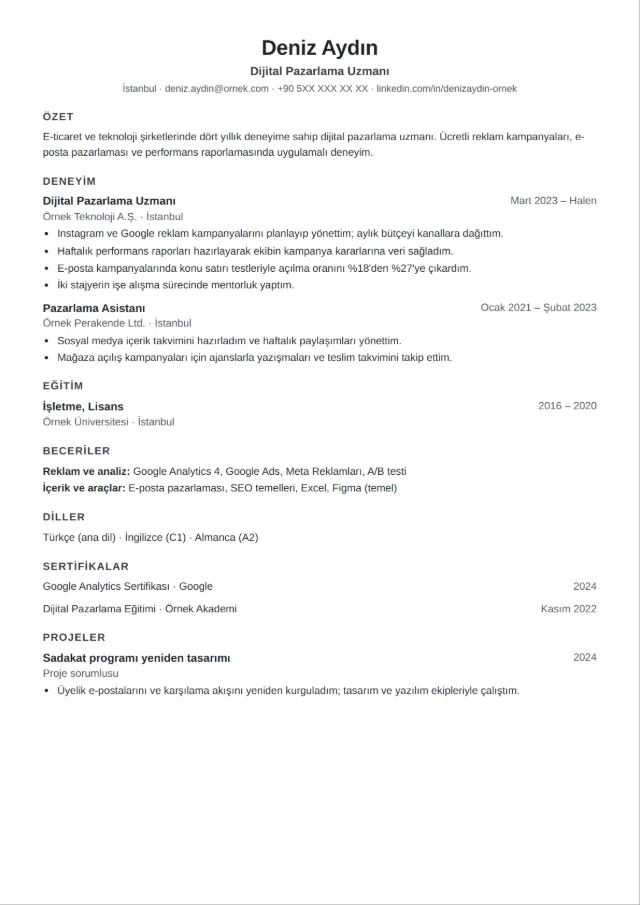
Kivilio CV is an AI-assisted resume builder with 4 templates on the Free plan; one of them, Compact, is built for new graduates and short resumes that fit on one page. If you'd rather lead with education and projects, the Graduate template does exactly that. It's a Pro template, but you can preview it with your own content on the Free plan. Word downloads are real paragraphs, PDFs have selectable text, and your first resume downloads without a watermark. You can compare every layout on the resume templates page.
Frequently asked questions
What do I put on my resume if I've never had a job?
Class and capstone projects, volunteer work, campus roles, and any informal work like tutoring, babysitting or freelance gigs. Write each one like a job: what you did, how you did it, and what came of it. Relevant coursework under Education also helps fill the gap.
Should I include my GPA?
If the application asks for it, yes. Otherwise, include it when it helps you and leave it off when it doesn't. Academic honors like dean's list are also worth a line under Education.
How long should an entry-level resume be?
In the US, one page. In the UK, a graduate CV is often one to two pages. Either way, more length should come from relevant detail, not filler.
Is it OK to use the same resume for every application?
You can, but small tailoring goes a long way. Adjust the last line of your summary, the order of your skills and which project sits first to match each posting.
Kivilio newsletter
New articles, product news and short tips.